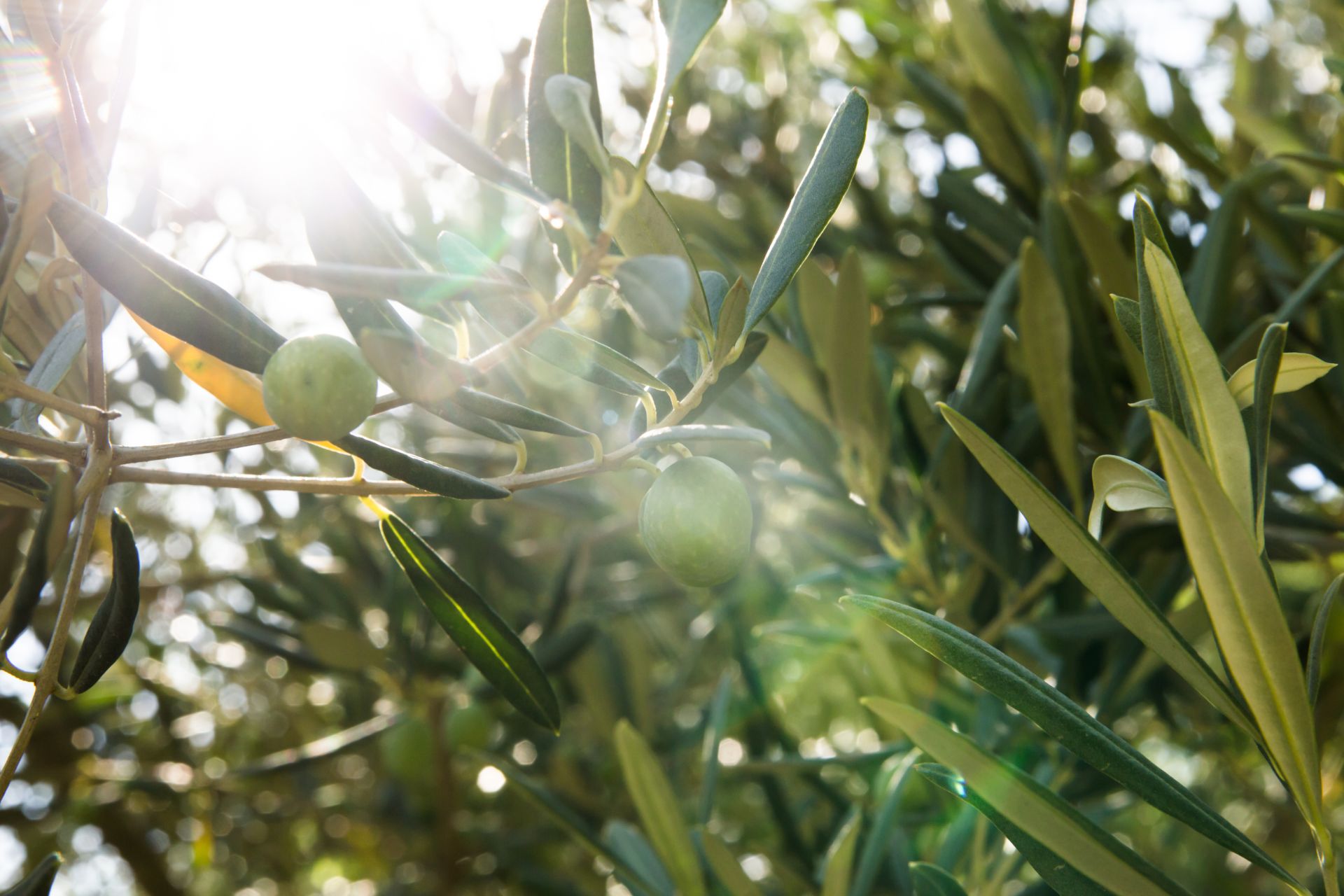
The olive tree is a blessed tree that thrives in the rocky and barren area of the Mediterranean. It produces fruit under adverse conditions of drought, strong winds and high temperatures, while its longevity and productivity has written the history of the Mediterranean peoples.
The history
The olive was enlightened, nourished, cured, crowned, groomed and identified with high ideals while inspiring the long-standing culture of the Eastern Mediterranean.
A symbol of knowledge, wisdom, abundance, peace, health, strength and beauty has been worshiped for thousands of years. It is a lively part of a heavy cultural heritage, with legends, traditions and religious rituals inherent to flowering, harvesting and production of olive oil.
Our olive tree has bequeathed an extremely complex bequest of values, prosperity and culture, which we have just recently been able to evaluate and defend.
The tree
The official name of evergreen olives is Olea Europea Sativa.
The domesticated olive tree originates from the eastern Mediterranean basin. It adapts to long-lasting dry and warm summers and shows extreme resistance at temperatures often reaching 0 ° C. The olive trees in their adult life are medium-sized trees. In some cases, the trees can reach even 10 meters. However, dwarfs-trees are also found for ornamental purposes.
In the Mediterranean area, the olive trees are blossoming at the end of Spring (from April to May) and the harvest starts from the end of November and ends in February for the more southern regions.
Historical facts of olive oil
In the Greek area, presses for the production of oil from olives and containers (jars) for oil storage dating from the Mycenaean era have been found.
According to the excavations carried out in the Proto-Cycladic II (2,700-2,300 BC) cemetery of Spedo in 1903 by Klonos Stefanos, among the other finds, he mentions a silver-plated clay vessel which had traces of spoiled olive oil.
The careful research in the chemistry of the National University under Professor K. Zeggeli proved, beyond doubt, the existence of olive oil.
Klonos Stefanos (in the Proceedings of the Archaeological Society 1906) notes that together with the silver-plated clay vessel, a triple clay oil lamp was found.
Olive oil is referred to on a Linear B tablet from Knossos as erawo and on others with a special ideogram.
The uses of the oil, apart from its use in food, were:
Virgin Olive Oil
According to the applicable quality classification “virgin olive oil” is:
The oil obtained only by mechanical methods or other natural treatments, under conditions which do not cause deterioration of the oil and which has not undergone any other treatment than washing, decantation, centrifugation and filtration.
Excluded oils obtained with solvents, with auxiliary receiving materials that have a chemical or biochemical effect, or with methods of re-esterification or mixing with oils of another nature.
Therefore, the “virgin olive oil” is the “natural juice” oil, which contains intact all the essential components contained in the olive fruit (vitamins, trace elements, trace elements, etc.) and by extension the one that has all the health benefits properties.
“Virgin olive oils” are classified in detail with the following names, depending on their content of free fatty acids (acidity) and with some special characteristics provided for each category:
Historical facts of Olive Oil
Nutritional information per 100g.
Vitamins and Trace Elements
From the USDA database
Information from Olive Oil – Wikipedia (wikipedia.org)